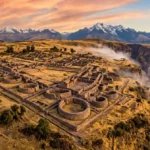
The Inca citadel of Machu Picchu, discovered by Hiram Bingham on July 24, 1911, is a UNESCO-recognized cultural heritage site. It is considered one of the most extraordinary and well-preserved archaeological monuments in the world.
📍 Geographic Location of Machu Picchu
Machu Picchu is located in the district of Machu Picchu Pueblo, in the province of Urubamba, within the Cusco region of Peru. The citadel sits at 2,400 meters above sea level.
The name Machu Picchu translates to “Old Mountain” in Spanish. Its stone structures unfold along the slopes of the mountain, bordered by a dramatic cliff that drops 400 meters into the Urubamba River canyon.
Despite decades of research, archaeologists have yet to fully decipher the history and original function of this stone city. The precision of its construction, stones fitted perfectly without mortar, has inspired countless theories and myths.
In 1983, UNESCO declared Machu Picchu a World Heritage Site, recognizing its plazas, aqueducts, watchtowers (like the Guardian’s House), observatories, solar clock, and agricultural terraces as masterpieces of Andean engineering and wisdom.
⏳ Visiting Time and Preservation Efforts
In the past, visitors could spend an entire day at Machu Picchu. Today, entry is limited to four hours per person, with scheduled time slots regulated by the Ministry of Culture. This strategy aims to prevent early deterioration of the site, a concern shared by guides, anthropologists, and environmentalists from UNSAAC (National University of San Antonio Abad del Cusco).
🌿 Climate and Environment
Machu Picchu borders the Amazon rainforest and has two distinct seasons:
- Dry season: May to August
- Rainy season: September to April
Temperatures can reach up to 26°C on sunny days, while cold mornings in June and July may drop to -2°C. The average temperature is around 16°C.
Geological Foundation
The citadel is built on a granite orogenic structure known as Vilcapampa. This white-gray granite is an igneous rock composed of 60% feldspar, 30% quartz, and 10% mica, giving it the durability to withstand six centuries of history.
🏔️ Surrounding Mountains
Machu Picchu is flanked by two iconic peaks:
- Machu Picchu Mountain (Old Mountain): Located above the entrance gate
- Huayna Picchu Mountain (Young Mountain): The most photographed peak, often seen in classic Machu Picchu images
📸 Top Sites to Visit Inside Machu Picchu
Once inside the citadel, the entire route is clearly marked. For unforgettable photos and must-see spots, don’t miss:
- Guardian’s House: The best panoramic viewpoint for postcard-worthy shots of Machu Picchu Mountain
- Three Windows: Located in the lower part of the citadel, showcasing unique Inca architecture
- The Tower (El Torreón): A finely crafted semicircular structure, similar to the walls of Qoricancha Temple
- Intihuatana: A solar ritual stone in the upper urban area, meaning “To Tie the Sun”
- Sacred Rock: A rabbit-shaped stone at the entrance to Huayna Picchu
- Temple of the Condor: Stand in front of the beak and take six steps back to see the full condor shape carved in stone
💬 Final Reflection
Many visitors leave Machu Picchu in awe, and most agree, no matter how many times you visit, you’ll always want to return.