The Sacred Valley of the Incas is home to some of the most remarkable archaeological sites in Peru. Here are the key destinations you shouldn’t miss when exploring this historic region:
🏰 Ollantaytambo
Located 93 km northeast of Cusco, Ollantaytambo is a classic Inca town named after the local chief Ollanta, who, according to legend, fell in love with one of Inca Pachacutec’s daughters and was punished for daring to love royalty.
The archaeological complex sits atop a hill overlooking the town and includes structures such as the Temple of the Sun, the Mañaracay (Royal Chamber), the Incahuatana, and the Princess Baths.
At the summit, a fortress made of carved stone terraces was built to defend the valley from jungle tribes. One of the best-preserved areas lies north of Hanan Huacaypata square, featuring 15 blocks of houses built atop finely carved stone walls.
🏛️ Pisac Archaeological Park
Located 32 km northeast of Cusco, Pisac is another iconic Inca town in the Sacred Valley. The site features finely assembled stone constructions, citadels, watchtowers, military fortresses, and astronomical observatories.
One of its most notable features is the Inca cemetery, considered the largest in the Americas.
🌾 Moray
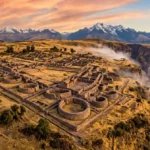
Moray is a fascinating site located 53 km northwest of Cusco. It showcases an impressive Inca agricultural laboratory built within a natural depression. The site consists of concentric terraces resembling a large amphitheater, with a vertical difference of up to 150 meters between the top and bottom levels.
The purpose of these terraces remains uncertain, but their depth and orientation create temperature differences of up to 15°C (27°F), which may have been used to study crop adaptation to various microclimates. Moray also features a sophisticated irrigation system.
🧂 Maras Salt Mines
Located 60 km (37 miles) from Cusco and just 7 km from Moray, the Maras Salt Mines are a unique site where beige and white salt layers are still harvested using ancient techniques.
Dating back to the Inca Empire, the community channels salty water from a spring called Qoripujio into man-made pools. As the sun evaporates the water, salt crystals form and are collected for sale.
With nearly 3,000 salt ponds, the view is spectacular. Locals proudly demonstrate traditional methods and even invite visitors to participate.