Holy Week in Cusco 2026: Traditions, the Lord of the Earthquakes, Fascinating Facts, Andean Syncretism, and an Unforgettable Experience
Holy Week in Cusco is one of the deepest, most moving, and most authentic religious and cultural celebrations in all of Peru. Every year, this festival transforms the former capital of the Inca Empire into a living stage of faith, solemnity, color, and centuries-old tradition. During Holy Week in Cusco 2026, which will take place from Sunday, March 29, to Sunday, April 5, thousands of local faithful, pilgrims from other regions of Peru, and international visitors will arrive in the Imperial City to participate in a week filled with processions, Masses, symbolic rituals, and unique cultural expressions.
Throughout Holy Week in Cusco, the cobblestone streets of the historic center—recognized as a UNESCO World Heritage Site—take on a special atmosphere. The aroma of incense blends with the scent of ñucchu flowers, the sound of church bells and pututus (conch shells used since Inca times) echoes through the air, and thousands of candles illuminate the cold Andean nights. This celebration not only commemorates the Passion, Death, and Resurrection of Jesus Christ but also highlights the rich cultural syncretism between the Catholic faith introduced by the Spanish and the ancestral Andean beliefs of the Quechua and Inca peoples.
The Holy Week in Cusco stands out for its ability to unite two spiritual worlds: European Catholicism and the Andean worldview that honors the Apus (sacred mountains), Pachamama (Mother Earth), and the forces of nature. This fusion makes the experience unique in the world and attracts visitors seeking not only faith, but also a profound cultural immersion.
The Lord of the Earthquakes: Complete History, Legends, and Fascinating Facts About Cusco’s Patron Saint
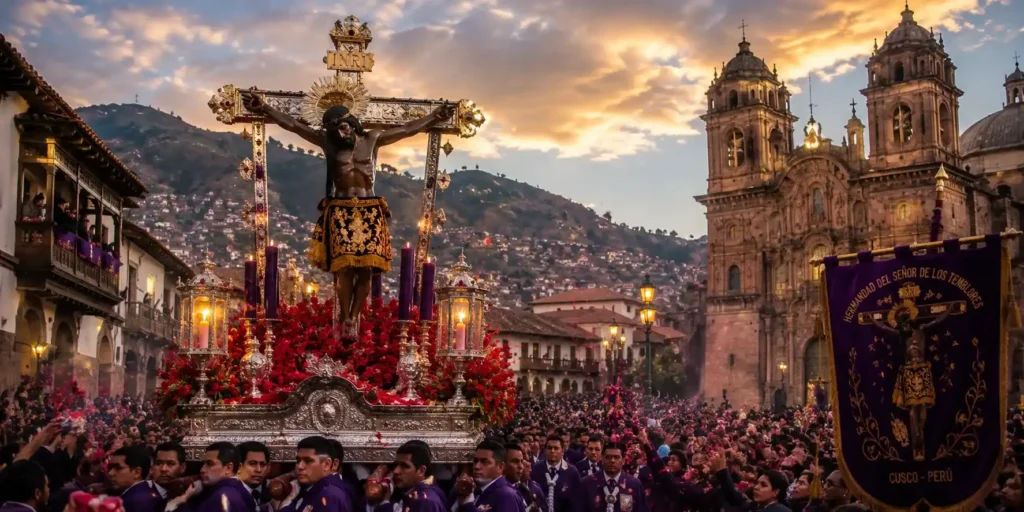
The true heart of Holy Week in Cusco beats around the revered image of the Lord of the Earthquakes, affectionately known as Taytacha de los Temblores, Cristo Moreno, or Taytacha Timplures in Quechua. He has been the Sworn Patron Saint of the City since 1741 and remains the ultimate symbol of protection, faith, and hope for the people of Cusco.
The history of the Lord of the Earthquakes dates back to the 16th century during the reign of King Philip II of Spain. According to the most widespread tradition, the king ordered a crucified Christ image to be carved in Seville with special features: copper-colored skin and mestizo facial characteristics, allowing the Indigenous peoples of the Viceroyalty of Peru to identify with it more easily and facilitating evangelization. The image was then shipped by sea toward Callao.
During the ocean crossing, the vessel encountered a powerful storm. In desperation, the priests removed the sculpture from its chest and secured it to the main mast, imploring divine intervention. Miraculously, the waters calmed, and the image became known as the Lord of the Storms.
Upon arriving on land, the image continued its journey toward Cusco. In Mollepata (present-day Anta Province), the chest became so heavy that the porters could no longer move it. Locals interpreted this as a divine sign that the image wished to remain there, so a replica was left behind while the original continued its route. Some versions suggest that the image that eventually reached Cusco was carved locally by artists from the Quito or Cusco Schools of Art.
The decisive moment occurred on March 31, 1650. A devastating earthquake of great magnitude struck Cusco for several days, destroying churches, colonial mansions, and causing widespread panic. In the midst of the chaos, residents remembered a crucified Christ image that had remained almost forgotten in a Cathedral workshop, originally known as the Lord of the Good Death or Christ of the Good Death. The image was taken out in an improvised procession and, according to local legend, at the precise moment it entered the Plaza de Armas, the tremors miraculously ceased.
From that moment on, the image was given the name Lord of the Earthquakes and was proclaimed the official protector of the city against earthquakes, epidemics, and natural disasters. In 1741, he was officially declared the Sworn Patron Saint of Cusco.
Fascinating Facts About the Lord of the Earthquakes:
- The smoke from thousands of beeswax candles lit by devotees year after year gradually darkened the image’s original color until it became the Cristo Moreno admired today. Neither the face nor the body has ever been repainted, preserving this “miracle of smoke” as part of its sacred history.
- More than 61 ancient letters written by devotees over the centuries have been discovered inside the image, requesting miracles related to health, protection, employment, and family reconciliation. Some of them are more than 200 years old.
- The bearers who carry the image belong to family brotherhoods that pass down this privilege from generation to generation. They wear purple or red tunics and carry the heavy platform with profound devotion.
- During the Holy Monday procession, devotees throw ñucchu petals (a red Andean flower used since Inca times) from balconies and windows. This red shower symbolizes the blood of Christ and represents a perfect example of syncretism: the Incas used ñucchu in rituals dedicated to the earth and the sun.
During Holy Week in Cusco 2026, the grand procession of the Lord of the Earthquakes will take place on Holy Monday, March 30, departing from the Cathedral at approximately 3:00 PM. It is estimated that between 60,000 and 80,000 people will accompany the Taytacha through the streets of the historic center. At the end of the procession, in the Plaza de Armas, one of the most emotional moments takes place: the Blessing of the Taytacha, where the image turns toward the four cardinal points while bells, sirens, and Andean pututus resonate throughout the city.
Andean-Catholic Syncretism: The Unique Essence of Holy Week in Cusco
One of the most fascinating and enriching characteristics of Holy Week in Cusco is the profound syncretism between the Catholic religion and pre-Hispanic Andean beliefs. Around this time of year (near the autumn equinox in the Southern Hemisphere), the Incas celebrated rituals of renewal of the earth, gratitude to the Apus, and offerings to Pachamama to ensure abundant harvests.
Today, many Cusqueños combine both traditions: they prepare despachos (Andean offerings made of coca leaves, sweets, flowers, and alcohol) while also participating in Catholic processions. In nearby rural communities, medicinal herbs are collected on Good Friday because it is believed that when they receive ñucchu petals—considered the “blood of Christ”—their healing properties are enhanced.
This syncretism is also reflected in the music, which blends Catholic hymns with Andean instruments, in the clothing worn by the bearers, and in the way Christ’s suffering is interpreted as a parallel to the historical suffering of the Andean people after the Spanish conquest.
Complete and Detailed Holy Week in Cusco 2026 Schedule
Holy Week in Cusco is experienced intensely day by day:
- Palm Sunday (March 29): Official beginning of Holy Week. Artistic woven palm fronds are blessed in the Cathedral and other churches from early morning. The blessed palms are kept in homes throughout the year as symbols of protection against illness and misfortune.
- Holy Monday (March 30): The central day of the celebration. Grand procession of the Lord of the Earthquakes. Thousands of devotees accompany the image with prayers, hymns, and showers of ñucchu petals.
- Holy Tuesday and Holy Wednesday (March 31 and April 1): Days dedicated to reflection, Masses, and the creation of beautiful flower carpets in neighborhoods such as San Blas, Santa Clara, and San Cristóbal. Petals of carnations, kantutas, and ñucchu are arranged into temporary religious designs through which the processions later pass.
- Holy Thursday (April 2): The Washing of the Feet ceremony takes place in the Cathedral, where the bishop washes the feet of 12 people in remembrance of Jesus and the Apostles. In the evening, devotees participate in the traditional Visit to the Seven Churches, visiting seven temples to meditate on Christ’s final journey.
- Good Friday (April 3): The day of greatest solemnity, fasting, and reflection. The Stations of the Cross are held, and families prepare the famous 12 Dishes without red meat.
- Holy Saturday (April 4): Easter Vigil celebrations and preparation for the Resurrection.
- Easter Sunday (April 5): Procession of the Risen Christ, celebrated in a more joyful and festive atmosphere.
Sacred Cuisine: The 12 Dishes of Good Friday During Holy Week in Cusco
Food is a central and symbolic element of Holy Week in Cusco. On Good Friday, families gather to prepare and share the traditional 12 Dishes, representing the 12 Apostles of the Last Supper. Red meat is strictly avoided as a sign of penance and respect for Christ’s sacrifice. Traditionally, the meal consists of six savory dishes and six sweet dishes.
Some of the most representative dishes include:
Savory Dishes:
- Qolla Lawa or corn lawa: a thick soup made from fresh corn.
- Friday Chupe: a hearty soup prepared with shrimp, broad beans, potatoes, and eggs.
- Lisas Soup or olluco soup.
- Mushroom Capchi or broad bean capchi.
- Fried Trout or poached fish.
- Quinoa Ají or meat-free stuffed rocoto pepper.
Sweet Dishes:
- Purple Corn Pudding (Mazamorra Morada).
- Rice Pudding (Arroz con Leche).
- Buñuelos and tawa tawa fritters.
- Candied Alcayota Squash.
- Sweet Empanadas and suspiros.
- Condesas or seasonal fruit compotes.
This gastronomy combines ancient Andean ingredients such as quinoa, kiwicha, corn, broad beans, and olluco with colonial culinary techniques, creating a unique fusion that perfectly reflects the cultural identity of Cusco.
Practical Tips and Recommendations for Experiencing Holy Week in Cusco 2026
If you plan to visit during Holy Week in Cusco, keep these recommendations in mind:
- Book your accommodation well in advance, especially in the Historic Center (San Blas, Plaza de Armas, or near the Cathedral).
- Bring comfortable clothing, warm layers (nighttime temperatures can drop to 41–46°F / 5–8°C), comfortable walking shoes, and sun protection.
- Respect the silence and solemnity of the processions. Avoid using flash photography near sacred images.
- Combine your religious experience with sightseeing: visit the Sacred Valley, Machu Picchu, Pallay Punchu Mountain, or the Inca Trail.
- Try the traditional 12 Dishes in local restaurants or, even better, in family homes that offer authentic culinary experiences.
- Maintain a respectful attitude: Holy Week in Cusco is, above all, an act of faith for the people of Cusco.
Holy Week in Cusco is not merely a religious celebration—it is a complete cultural experience that brings together deep faith, colonial history, Inca heritage, rich gastronomy, and the majestic beauty of the Andes. It is the perfect time to understand the identity of Cusco and take a piece of this sacred land home in your heart.
If you are looking for a destination where devotion, tradition, and culture intertwine in a unique way, Holy Week in Cusco 2026 is undoubtedly one of the best experiences in South America. Come and experience a celebration that has withstood the passage of centuries and continues to move both locals and visitors alike.
Frequently Asked Questions About Holy Week in Cusco 2026
When is Holy Week celebrated in Cusco in 2026?
Holy Week in Cusco 2026 will take place from Sunday, March 29, to Sunday, April 5, 2026. The most important day is Holy Monday (March 30), when the Lord of the Earthquakes procession takes place.
Who is the Lord of the Earthquakes?
The Lord of the Earthquakes (Señor de los Temblores) is the patron saint and protector of Cusco. According to local tradition, his image miraculously stopped the devastating earthquake of March 31, 1650. Since then, he has been venerated as the city’s protector against earthquakes, epidemics, and natural disasters.
What makes Holy Week in Cusco different from other celebrations?
Holy Week in Cusco is unique because of its strong blend of Catholic traditions and ancient Andean beliefs. Rituals involving Pachamama, the Apus, coca leaves, and ñucchu flowers coexist with Catholic processions, Masses, and ceremonies, creating one of the most distinctive religious celebrations in Latin America.
What are the 12 Dishes of Good Friday?
The traditional 12 Dishes represent the 12 Apostles of the Last Supper. Families prepare six savory dishes and six desserts, avoiding red meat as a sign of penance. Popular dishes include chupe de viernes, fried trout, quinoa-based recipes, rice pudding, purple corn pudding, and buñuelos.
Is Holy Week in Cusco suitable for tourists?
Absolutely. Holy Week is one of the best times to visit Cusco if you are interested in culture, history, religion, and local traditions. Visitors can attend processions, explore historic churches, experience traditional cuisine, and witness one of Peru’s most important cultural celebrations.
Do I need to reserve accommodation in advance?
Yes. Hotels in Cusco experience high demand during Holy Week, particularly around Plaza de Armas, San Blas, and the Historic Center. It is recommended to reserve accommodations several months in advance.
Conclusion: A Sacred Journey Through Faith, History, and Culture
Experiencing Holy Week in Cusco 2026 means witnessing one of South America’s most powerful expressions of faith and cultural identity. Few celebrations combine such profound religious devotion with centuries-old traditions, indigenous symbolism, colonial heritage, and living history.
The procession of the Lord of the Earthquakes, the fragrance of ñucchu flowers, the sound of Andean pututus echoing through the Plaza de Armas, and the preparation of the traditional 12 Dishes create an atmosphere unlike anywhere else in the world.
Whether you arrive as a pilgrim, a cultural traveler, a photographer, or simply a curious visitor, Holy Week in Cusco offers an unforgettable opportunity to understand the soul of the Andes. It is a celebration where past and present meet, where Catholic and Andean traditions coexist, and where every procession, prayer, and ritual tells a story that has endured for centuries.
For travelers seeking authenticity, spirituality, history, and cultural immersion, Holy Week in Cusco 2026 is not simply an event—it is a journey into the heart of Peru.