Qhapaq Ñan in Peru: The Ancient Inca Road System Explained
The Inca Empire was one of the most extraordinary civilizations in human history — and at the heart of its power lay an engineering marvel that connected an entire continent. The Qhapaq Ñan, or Royal Inca Road, was the backbone of Tawantinsuyu, the vast empire that stretched across six modern-day countries. Today, this ancient network of paths continues to wind through the Andes, offering travelers a rare window into a civilization that shaped the Americas forever.
Table of Contents
What is the Qhapaq Ñan?
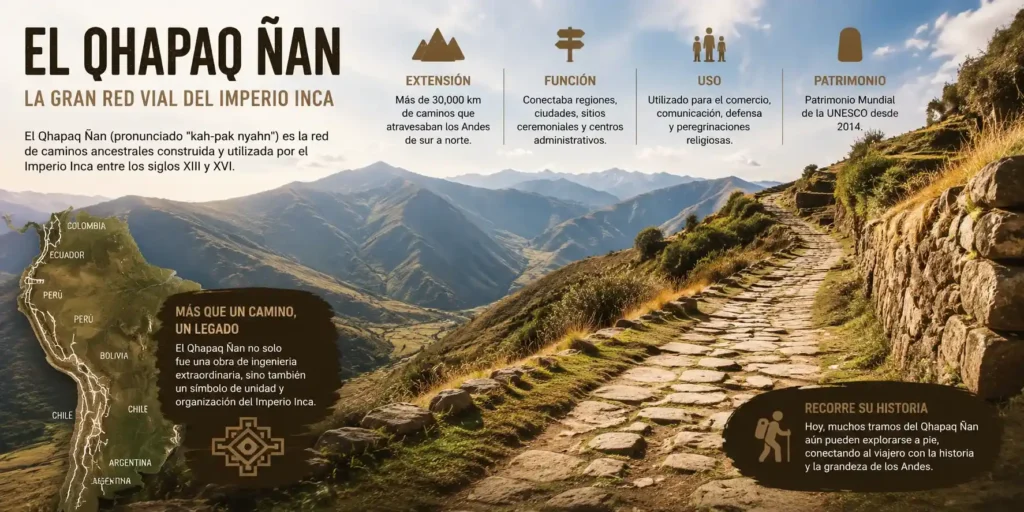
The Qhapaq Ñan (pronounced “kah-pak nyahn”) is the ancient road network built and used by the Inca Empire between the 13th and 16th centuries. In Quechua, the language of the Incas, Qhapaq means “powerful” or “rich,” and Ñan means “road” or “path.” Together, the name translates roughly as the “Great Inca Road” or “Royal Road.”
This was not a single road but an interconnected system of more than 30,000 kilometers of trails, crossing deserts, jungles, highlands, and coastal plains. The roads linked the four regions of the Inca Empire — Chinchaysuyu (north), Antisuyu (east), Qollasuyu (south), and Kuntisuyu (west) — all converging at the heart of the empire: Cusco, the sacred capital.
The roads were primarily built for administrative and military purposes, allowing the Inca state to move armies, transport goods, and communicate across vast distances. Chasquis — trained relay runners — used the network to deliver messages across the empire in a matter of days, a feat that would be remarkable even by modern standards.
Quick Fact
The Qhapaq Ñan spans 30,000+ km across 6 countries — comparable in scale to the Roman road system, yet built without wheels, iron tools, or horses.
History of the Inca Roads
The inca road system did not emerge overnight. Its origins trace back to pre-Inca cultures that had already begun building trails across the Andes. However, it was under the reign of the Sapa Inca — particularly Pachacuti Inca Yupanqui in the 15th century — that the road network was dramatically expanded and standardized into the sophisticated system we know today.
Construction of the Qhapaq Ñan was a monumental task accomplished without the use of wheels, iron tools, or draft animals large enough to carry heavy loads. Instead, the Incas relied on an extraordinary system of communal labor called mit’a, in which communities across the empire contributed work in exchange for food, clothing, and protection from the state.
The roads were engineered with remarkable precision across every type of terrain:
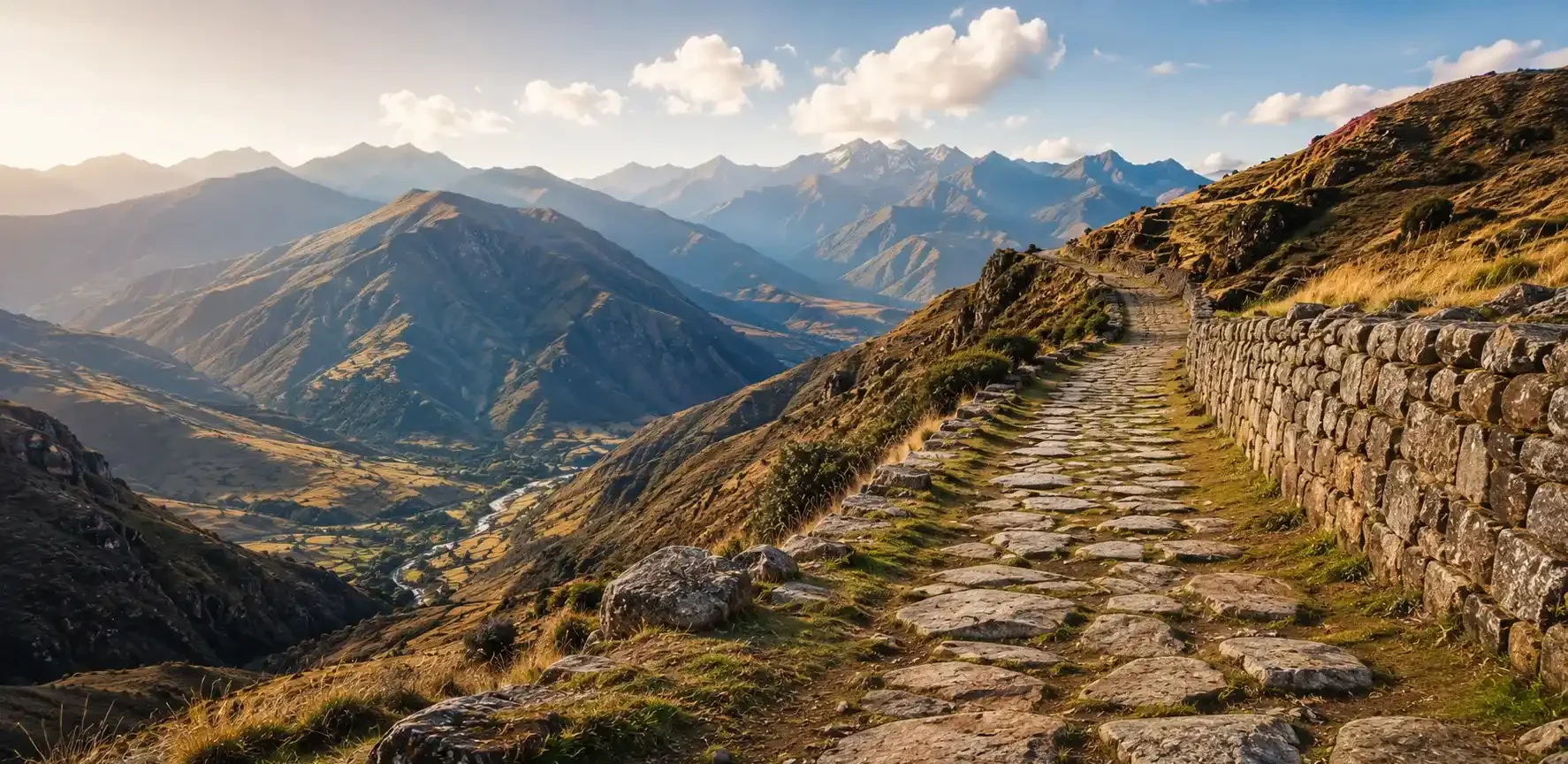
- Stone paving on steep mountain sections to prevent erosion and ensure year-round usability
- Drainage systems to manage rainfall in the highlands and prevent flooding
- Suspension bridges made from braided plant fibers — some spanning more than 50 meters — to cross rivers and gorges
- Steps carved into cliffs to navigate near-vertical Andean terrain
- Tambos — rest stations placed at regular intervals — where travelers, soldiers, and chasquis could eat, sleep, and resupply
At its peak, the qhapaq nan peru connected what is today Colombia, Ecuador, Peru, Bolivia, Argentina, and Chile — making it one of the largest road networks in the ancient world.
UNESCO Recognition
In 2014, the Qhapaq Ñan was inscribed on the UNESCO World Heritage List as a transnational site shared by six countries: Argentina, Bolivia, Chile, Colombia, Ecuador, and Peru. This was a landmark recognition of its outstanding universal value — not just as an archaeological monument, but as a living cultural landscape that continues to influence communities along its route.
UNESCO highlighted three key aspects of the road system’s significance:
- Exceptional engineering — the technical achievement of building such a vast network across extreme terrain without modern tools
- Cultural connectivity — its role in connecting diverse ecosystems, languages, and civilizations across an entire continent
- Living heritage — its ongoing significance for indigenous communities who still use sections of the ancient trails for traditional ceremonies, agriculture, and trade
The inscription covers approximately 30,000 kilometers of roads along with more than 270 associated sites — including tambos, settlements, ceremonial centers, and agricultural terraces. For Peru, this recognition brought renewed investment in the preservation of the qhapaq nan cusco region, which contains some of the best-preserved sections of the entire network.
Famous Routes in Peru
Peru contains the largest and most diverse sections of the Qhapaq Ñan, running from the tropical Amazon lowlands to the high-altitude puna grasslands and the arid coastal desert. Here are the most significant routes:
The Royal Road of the Sierra
The main highland route ran from Quito in modern Ecuador all the way to Mendoza in Argentina, passing through Cusco. This was the most important road in the empire, connecting the major administrative and ceremonial centers of Tawantinsuyu.
The Coastal Road
Running parallel to the Pacific Ocean, this route connected coastal cities and fishing communities from northern Peru down to Chile. Unlike the highland roads, much of this route crossed desert terrain and required a sophisticated system of stone markers to guide travelers across featureless landscape.
The Inca Trail to Machu Picchu
Perhaps the most famous section of the ancient inca trails in the world, the Classic Inca Trail is a 43-kilometer route that follows original Inca paving from Km 82 at Piscacucho through stunning mountain scenery and past remarkable archaeological sites — Runkurakay, Sayacmarca, Phuyupatamarca, and Wiñaywayna — before arriving at the Sun Gate (Inti Punku) with its iconic first view of Machu Picchu.
The Salkantay Route
The Salkantay Trek follows ancient pathways beneath the sacred Salkantay peak (6,270 msnm), crossing from the highland puna into cloud forest and subtropical jungle before reaching Machu Picchu. This route was used by Andean communities for centuries and passes through some of the most breathtaking landscapes in the entire Andes.
T’aqrachullo and the Qhapaq Ñan
One of the lesser-known but most remarkable sections of the qhapaq nan peru is found near T’aqrachullo — a remote area that preserves some of the most intact original Inca road surfaces anywhere in the country.
The T’aqrachullo route offers trekkers the rare opportunity to walk on original stone-paved Inca roads that have remained largely unchanged for over 500 years. Unlike the heavily visited Classic Inca Trail, this section sees very few travelers — giving visitors an authentic and deeply immersive experience of what it truly meant to journey through the Inca Empire.
The trail winds through high-altitude grasslands, past ancient agricultural terraces and small communities where Quechua is still the primary language spoken daily. It is a powerful reminder that the Qhapaq Ñan was never just an archaeological relic — it has always been a living road, connecting people to the land and to each other across generations.
Hiking the Ancient Roads Today
For modern travelers, the inca trail history comes alive most powerfully when experienced on foot. Several routes along the Qhapaq Ñan are accessible to trekkers of varying fitness levels, making this ancient road network one of the most extraordinary hiking destinations in the world.
Classic Inca Trail — 4 Days
The most iconic way to experience the Qhapaq Ñan In Peru. The Classic Inca Trail requires a permit that must be booked months in advance — only 500 people per day are allowed on the trail, including guides and porters. The four-day journey is physically demanding but deeply rewarding, ending with a sunrise arrival at Machu Picchu through the ancient Sun Gate.
Salkantay Trek — 5 Days
The Salkantay Trek is the most popular alternative to the Classic Trail and does not require a permit. It passes beneath the glaciated peak of Salkantay, through diverse ecosystems, and arrives at Machu Picchu from the jungle side — a completely different and equally spectacular perspective on the ancient road network.
🎒 Practical Tips for Hiking the Qhapaq Ñan
- Acclimatize in Cusco for at least 2 full days before beginning any highland trek — altitude sickness above 3,000 msnm is a real concern
- Book Inca Trail permits early — they sell out 6 months in advance, especially May to September
- Hire a licensed guide — required on the Classic Trail and invaluable for understanding the history of the road
- Pack for variable weather — the Andes can bring sunshine, rain, and cold temperatures all in a single day
- Respect the trail — the Qhapaq Ñan is a UNESCO World Heritage Site and sacred to Andean communities
Whether you walk a few kilometers of original stone paving near Cusco or complete the full four-day journey to Machu Picchu, hiking the Qhapaq Ñan is an experience that connects you directly to one of the greatest civilizations the world has ever known. The roads of the Incas were built to last — and they have, for more than 500 years.
Start Your Adventure
Ready to Walk the Roads of the Incas?
Explore our selection of Inca Trail treks, Salkantay adventures, and Cusco tours designed for every traveler.