Colca Canyon guide 2026 — Condors, Viewpoints & Everything You Need to Know
The Colca Canyon is one of the most extraordinary destinations in Peru — and one of the most underestimated by travelers who plan their trip thinking only about Machu Picchu. At over 13,000 feet (4,000m) deep at its deepest point, it is one of the deepest canyons on Earth, surpassing the Grand Canyon of the Colorado in the United States. But what truly makes the Colca special is not just its depth — it’s the spectacle of the Andean condor soaring past its walls just meters from visitors.
This guide covers everything you need to know to visit the Colca Canyon in 2026 from Arequipa or from Cusco, with updated data on prices, schedules, and the secret to maximizing your chances of seeing condors.
What Is the Colca Canyon — Essential Facts
The Colca Canyon is located in the Arequipa region of Peru, in Caylloma province, approximately 94 miles (151 km) from Arequipa city — about 3 hours by road. It stretches over 125 miles (200 km) in length and reaches depths of between 11,800 and 13,650 feet (3,600–4,160m) depending on the sector.
| Fact | Information |
|---|---|
| Maximum depth | ~13,650 ft / 4,160m (north side) |
| Length | 125+ miles / 200+ km |
| Altitude of Chivay | 11,926 ft / 3,635m |
| Altitude Cruz del Cóndor | 10,784 ft / 3,287m |
| Altitude Volcanes Viewpoint (en route) | 16,109 ft / 4,910m — highest point of the tour |
| Main town | Chivay |
| Distance from Arequipa | ~94 miles / 151 km (3 hours by car) |
| Tourist Ticket | S/70 international · S/40 Latin American · S/20 Peruvian |
💡 Surprising fact: The Colca Canyon is Peru’s second most visited destination, surpassed only by Machu Picchu. And yet most travelers who arrive in Lima or Cusco have never heard of it.
The Andean Condor — The Star of the Colca
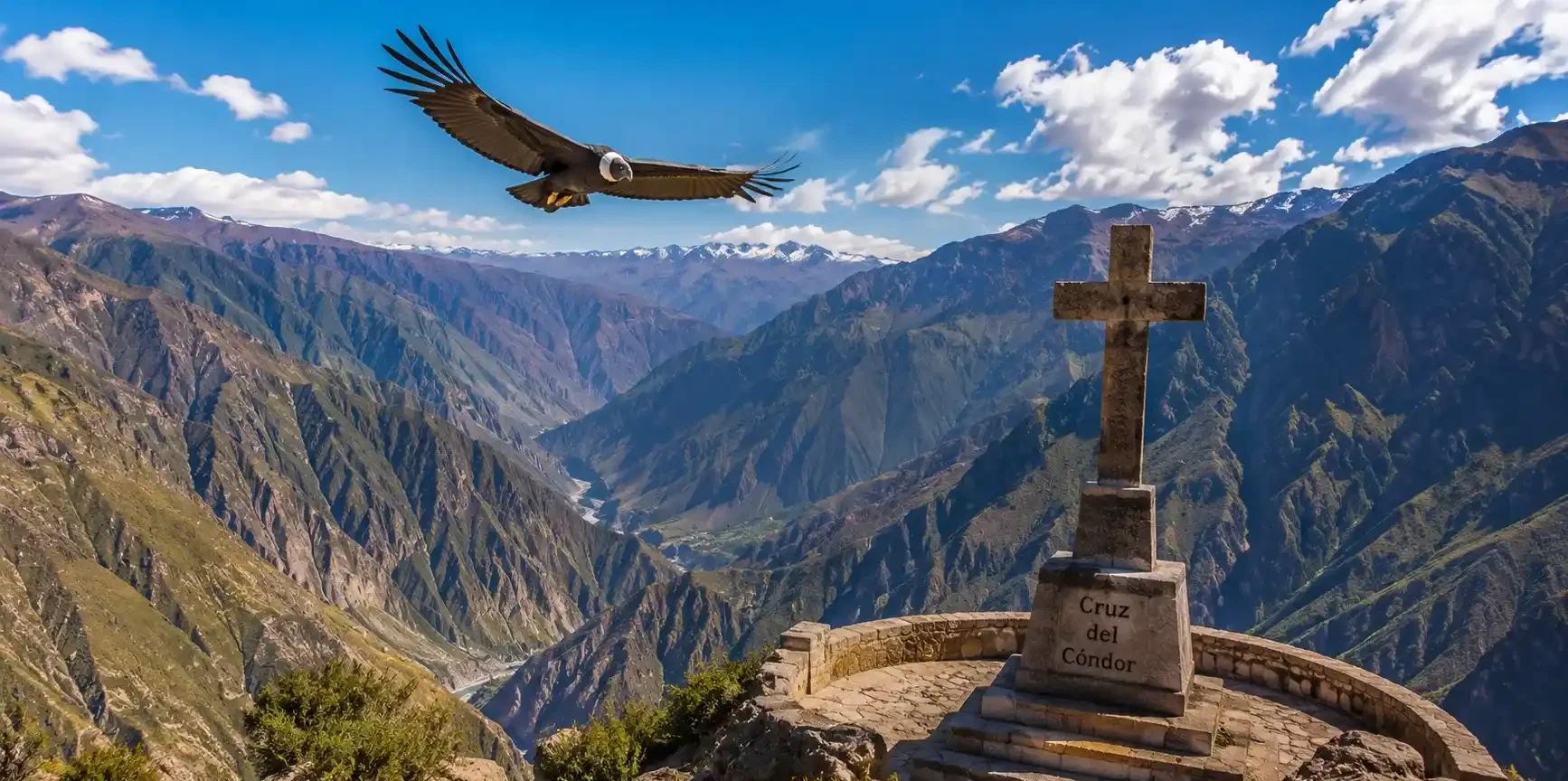
The Andean condor (Vultur gryphus) is the largest flying bird on Earth — with a wingspan of up to 10.5 feet (3.2m) and a weight of up to 33 lbs (15 kg). It is also one of the longest-lived birds in the world, capable of living over 70 years in the wild.
For Andean cultures, the condor represents the connection between Earth and the sky — the messenger between the world of the living and the Hanan Pacha (the Inca celestial world). Watching it soar above the Colca Canyon is not just a natural spectacle — it’s an experience with centuries of cultural significance.
Why the Colca is the Best Place on Earth to See Condors
The canyon creates ascending thermal currents from the temperature difference between the canyon floor and the upper rims. Condors — which barely flap their wings but glide on these currents — use them to rise effortlessly to incredible heights. The combination of narrow walls and rising air means condors fly just meters from the viewpoints, offering sightings that are simply not possible anywhere else in the world.
Cruz del Cóndor Viewpoint — The Essential Stop
The Cruz del Cóndor is the main viewpoint of the Colca Canyon and the location with the highest condor sighting probability. Located at 10,784 ft (3,287m), approximately 2 hours from Chivay along the canyon route.
- 🦅 Best time to see condors: between 6:30 AM and 9:00 AM. Thermal air currents make condors fly higher and further as the day progresses. The earlier you arrive, the closer you’ll see them.
- 📅 Best season: dry season (May–November). During the rainy season (December–March) some condors migrate to other areas.
- ⏱️ Time at the viewpoint: 45 minutes to 1 hour.
- 🎫 Entry: included in the Colca Valley Tourist Ticket (S/70 for international visitors).
What to See at the Colca Canyon — Beyond the Condors
Chivay — The Valley’s Base Town
Chivay (11,926 ft / 3,635m) is the main town of the Colca Valley and the starting point for all tours. It has good accommodation, restaurants, and the most active artisan market in the valley. Most 1-day tours stop here for breakfast before continuing to the canyon.
Yanque Thermal Baths
7 km from Chivay, the Yanque hot springs (also known as La Calera) are natural thermal pools on the banks of the Colca River, with temperatures of 86–100°F (30–38°C). The view from the pools, with the Mismi snowcap in the background, is spectacular. Open from 5:00 AM — many tours stop here on the return journey.
The Oasis of Sangalle
At the bottom of the canyon, a 3–4 hour trek from the upper rim, lies a small oasis known as Sangalle or “Paradise” — with palm trees, a natural pool, and basic accommodation. Accessible only on foot (or by mule). It’s the endpoint of the classic 2–3 day Colca trekking route.
The Terraced Fields — Pre-Inca Agriculture Still in Use
Along the Colca hillsides, over 250,000 acres (100,000 hectares) of agricultural terraces built by the Cabana and Collagua cultures before the Inca expansion are still actively farmed today. They are the most extensive pre-Inca terraces in all of South America.
The Volcanes Viewpoint (Patapampa)
On the outbound route from Arequipa, the road passes through the Volcanes Viewpoint at 16,109 ft (4,910m) — the highest point of the tour. From here you can see several Arequipa volcanoes simultaneously, including Mismi (source of the Amazon River), Ampato, and Sabancaya (currently active). This is also the point where altitude is felt most strongly — a mandatory stop for acclimatization and coca tea.
1 Day or 2 Days at the Colca Canyon?
| Option | What It Includes | Best For | Approx. Price |
|---|---|---|---|
| 1 Day (Full Day) | Arequipa → Volcanes viewpoint → Chivay breakfast → Cruz del Cóndor → viewpoints → Arequipa | Travelers with limited time who primarily want to see the condors | $35–55 USD |
| 2 Days | Day 1: Arequipa → Chivay → thermal baths → overnight. Day 2: Cruz del Cóndor at dawn → trekking or viewpoints → Arequipa | Those who want condors in the best light and time to explore the valley | $80–130 USD |
| 2–3 Day Trek | Descent to canyon floor → Sangalle oasis → ascent on Day 2 | Trekking enthusiasts with good fitness and altitude acclimatization | $120–180 USD |
💡 Aremika Travel’s recommendation: If time allows, the 2-day tour is significantly better. Arriving at Cruz del Cóndor at dawn on the second day — when there’s almost no one else there and the light is perfect — is a completely different experience from the 1-day tour where you arrive alongside dozens of other groups. Sleeping in Chivay also meaningfully improves altitude acclimatization.
How to Get to the Colca Canyon from Arequipa
- 🚌 Bus from Arequipa (Terminal Terrestre): buses to Chivay depart from 7:00–8:00 AM. Duration ~3–4 hours, price S/15–25. Budget-friendly but no guide.
- 🚐 Organized tour by private minivan: the most efficient option. Hotel pickup, certified guide, breakfast in Chivay, and return. From $35 USD (1 day).
- 🚗 Own vehicle or rental: the route from Arequipa is paved to Chivay. Drive carefully on the high-mountain curves and the Volcanes pass at 16,109 ft.
How to Get to the Colca Canyon from Cusco
Many travelers include the Colca as part of the Cusco → Puno → Arequipa → Colca circuit. There is no direct access from Cusco — you must first reach Arequipa (by bus ~8–9 hours, or flight ~1 hour) and then take the tour from there. If you have at least 2 weeks in Peru, this southern circuit is one of the most complete and rewarding in the country.
Colca Tourist Ticket 2026
To enter the Colca Canyon viewpoints, including Cruz del Cóndor, the Colca Valley Tourist Ticket is mandatory:
- 💳 International visitors: S/70 soles (~$18 USD)
- 💳 Latin American visitors: S/40 soles
- 💳 Peruvian nationals: S/20 soles
Available at the entry checkpoint before Chivay. Bring your original passport — required for the migration checkpoint on the route and for the ticket.
Practical Tips for the Colca Canyon
- 🏔️ Prior acclimatization: the route reaches 16,109 ft. Spend at least 1 night in Arequipa (7,661 ft) before the tour to reduce altitude sickness risk.
- 🧥 Layer your clothing: pre-dawn temperatures at the Colca can drop below 32°F (0°C). Midday can exceed 68°F (20°C). Bring a warm jacket, rain gear, and light layers.
- ☀️ SPF 50+ sunscreen: UV radiation at 10,000–16,000 ft is extreme.
- 🍵 Coca tea and water: your guide will offer coca tea at the Volcanes viewpoint — always accept it. Stay hydrated throughout.
- 📷 Charged camera battery: cold pre-dawn temperatures drain batteries quickly. Bring a spare or a power bank.
- 🦅 Binoculars: not essential but significantly improve the experience when condors are soaring high.
Frequently Asked Questions
Is seeing condors at the Colca guaranteed?
There’s no absolute guarantee, but in dry season (May–November) sighting probability is very high. In over 90% of tours during dry season, condors are spotted at Cruz del Cóndor. During the rainy season probability drops as some condors migrate to other areas.
Is the trek to the canyon floor difficult?
The descent to the Sangalle oasis takes 3–4 hours with significant elevation loss. The ascent on the second day is more demanding — about 3,900 feet (1,200m) of vertical gain in 3–4 hours. It requires good physical fitness and prior altitude acclimatization.
Can I visit the Colca Canyon independently without a tour?
Yes — there are buses from Arequipa and accommodation in Chivay. However, without a guide you miss most of the historical and cultural context of the valley, and the logistics of viewpoints and timing can be complicated without knowing the route.
Ready for the Colca Canyon?
1-day tour from $35 USD · 2-day tour from $80 USD · Certified guide · Breakfast included
Daily departures from Arequipa · Also available as part of the South Peru circuit